
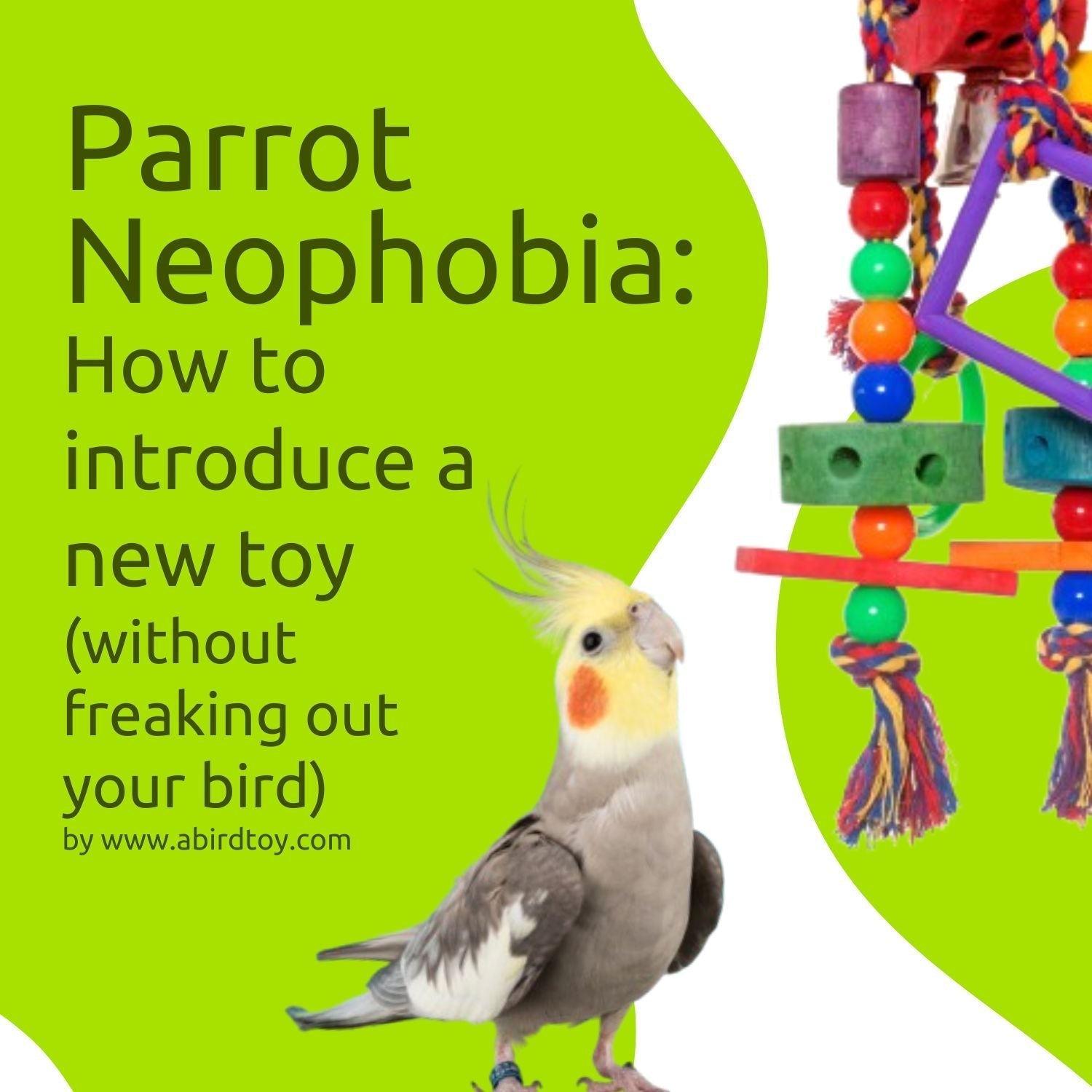
Ever picked up a parrot toy you were sure your bird would love, only for your feathered pal to cower in fear every time they see it? Disappointing, but not unusual: parrots are notorious for their apprehensive natures. But there’s no reason to give up (or traumatize your bird trying to force the toy on them)!
Parrot neophobia is very common, but it’s not insurmountable. In this post, let’s have a look at why parrots are often scared of new things—and how to introduce new toys without scaring the feathers off your flock.
Why are parrots neophobic?
Whether it’s a tiny budgie or a big macaw, if you’ve had your parrot for a while, you’ve probably observed neophobic behaviors at some point. These can be related to you, like when your bird suddenly refuses to come near you when you wear a hat or paint your nails. Food is also a big one, which is why it’s so hard to switch a parrot from seeds to healthier alternatives. And toys? Well, those can be absolutely terrifying (if you’re a parrot!).
Our parrots being big feathered wimps can be incredibly frustrating when you’re trying to do something nice for yours like give it a new toy, but looking at it from their point of view, it actually makes sense. Remember, no psittacine is domesticated—they still run on wild bird software. And for a wild bird, approaching new things with a very apprehensive attitude can mean the difference between life and death.
As a 2002 study on neophobia in parrots explains, this behavior is a matter of risk avoidance, not necessarily avoidance of novelty. Even highly curious parrot species can be neophobic! The highest instance of neophobia was found in parrots that frequently eat insects: bugs can be very toxic, so sometimes it’s best to just stick to the ones you know and not risk it. As silly as it might seem in our homes, it makes sense in nature.
Now, it’s important to keep in mind that although neophobia is inherent to parrots, how strongly they display it varies per bird. Early (and to a lesser degree, later) socialization makes a big difference! That’s why we often see stronger neophobia in rescue birds, for example. A parrot that’s spent its entire life locked in a bare cage can be terrified of even the most basic toys and perches. It’s just not used to new things, so go very slow.


Our team member's budgie initially cowered at his new Ferris wheel toy. With careful food-based desensitization, he eventually discovered a life-long hobby of flinging it across the room! Hey, whatever works for them...
How to introduce a new toy to your parrot
Although neophobia is helpful to wild birds, it can also prove inhibiting to their captive counterparts. Boredom is a big problem in pet parrots, but it’s difficult to offer enrichment if your bird is scared of everything. We want our parrots to be resilient so they can enjoy playing and exploring. So what do you do if yours freaks out at anything even remotely unfamiliar?
Meet your new best friend, DESENSITIZATION: reducing the emotional or behavioral response to a specific stimulus through repeated exposure. And that doesn’t mean repeatedly terrifying your bird by shoving the new toy in its face—it means figuring out what level of exposure is acceptable, and then slowly working your way up. No enforcement. No punishment. Just patience and understanding!
Parrot expert Susan Friedman explained it like this in 2002: “the bird is slowly presented with tolerable amounts or durations of the feared object or condition. The bird is never allowed to experience a high level of fear. When the bird shows comfort behaviors at one level on the fear hierarchy (such as preening or shaking tail feathers) the bird is rewarded with praise or other reinforcers and the feared object is moved one bit closer to the bird or the bird moved closer to the feared condition. This gradual process is continued until the bird shows no fear whatsoever when presented with the feared object or situation.”
There are three basic desensitization techniques, tailored to how parrots tick, that you can give a shot.
1. Neutral space
In the 2002 study, when new items were placed in a parrot’s “safe zone”—next to its food bowl at the normal feeding time—it would respond more fearfully than in a neutral space. Placing the new toy on top of the cage initially will, quite logically, freak your parrot out much less than setting it inside next to its favorite sleeping perch.
You can leave the toy for a week or so, allowing your bird time to get used to it. If it seems comfortable, start slowly inching the toy towards the intended spot, first outside and then inside the cage. Take a step back if you notice any stress.
2. Food
We’ve said it before, and we’ll say it again: our parrots would sell us for a sunflower seed. They evolved to be some of nature’s most clever food finding experts, and they're incredibly food-motivated.
If your parrot gives the new toy a wide berth, a few of its favorite snacks strategically placed around it may just convince it to approach. Eventually, you could even set the food on top of the toy. Alternatively, if the bird is target trained, you can see if it’ll follow the target stick to approach or touch the toy in exchange for a high-value treat.
Tip: if your parrot already has a favorite toy, placing that next to the new item can be effective as well. You can also keep it around you if you’re the bird’s favorite person.
3. Social learning
Parrot see, parrot do—it’s true. These highly social birds look to their flock when they’re unsure what to do, often copying their peers’ behaviors. This is called social learning: the process of learning by observing others' behaviors and the associated consequences, rather than through direct experience (although in parrots, it seems sometimes sheer envy does play a part as well!).
To your pet parrot, you’re part of the flock. If you enthusiastically play with the new toy, giving it all your attention, that may just motivate your bird to at least check it out.
Patience, patience, patience
Remember that not all parrots react the same to new items, and not all of them overcome neophobia equally quickly. Just slowly work your way through the techniques listed above and go back a step if your bird appears stressed. Its body language will tell you how it’s feeling. Don’t forget to reward any progress with lavish praise and a treat!
Managed to get your parrot to play with its new toy? Don’t stop now! Start over with a different item (maybe a new food?) and keep the anti-neophobia battle going. If you constantly—but gently—introduce your bird to new items that end up being fun or tasty, it’ll eventually lose much of its fear. No more cowering in front of new toys, but an assertive and self-confident parrot that likes to explore and knows how to keep itself busy.
Conclusion
Fear of new things, or neophobia, is a normal parrot behavior. If you’re struggling to get your bird to overcome its fear of new toys, desensitization training is the way to go. Try to be patient and trust the process: it can take weeks or more, but eventually, your parrot will get the memo.
Clark, P. (2019, November 14). Parrots and neophobic behavior. Pamela Clark Online. https://pamelaclarkonline.com/2019/11/14/parrots-and-neophobic-behavior/
Friedman, S. G. (2002). Alternatives to parrot breaking. BehaviorWorks. https://www.behaviorworks.org/files/articles/Alternatives%20to%20Parrot%20Breaking%202002.pdf
Mettke‐Hofmann, C., Winkler, H., & Leisler, B. (2002). The significance of ecological factors for exploration and neophobia in parrots. ethology, 108(3), 249-272.


