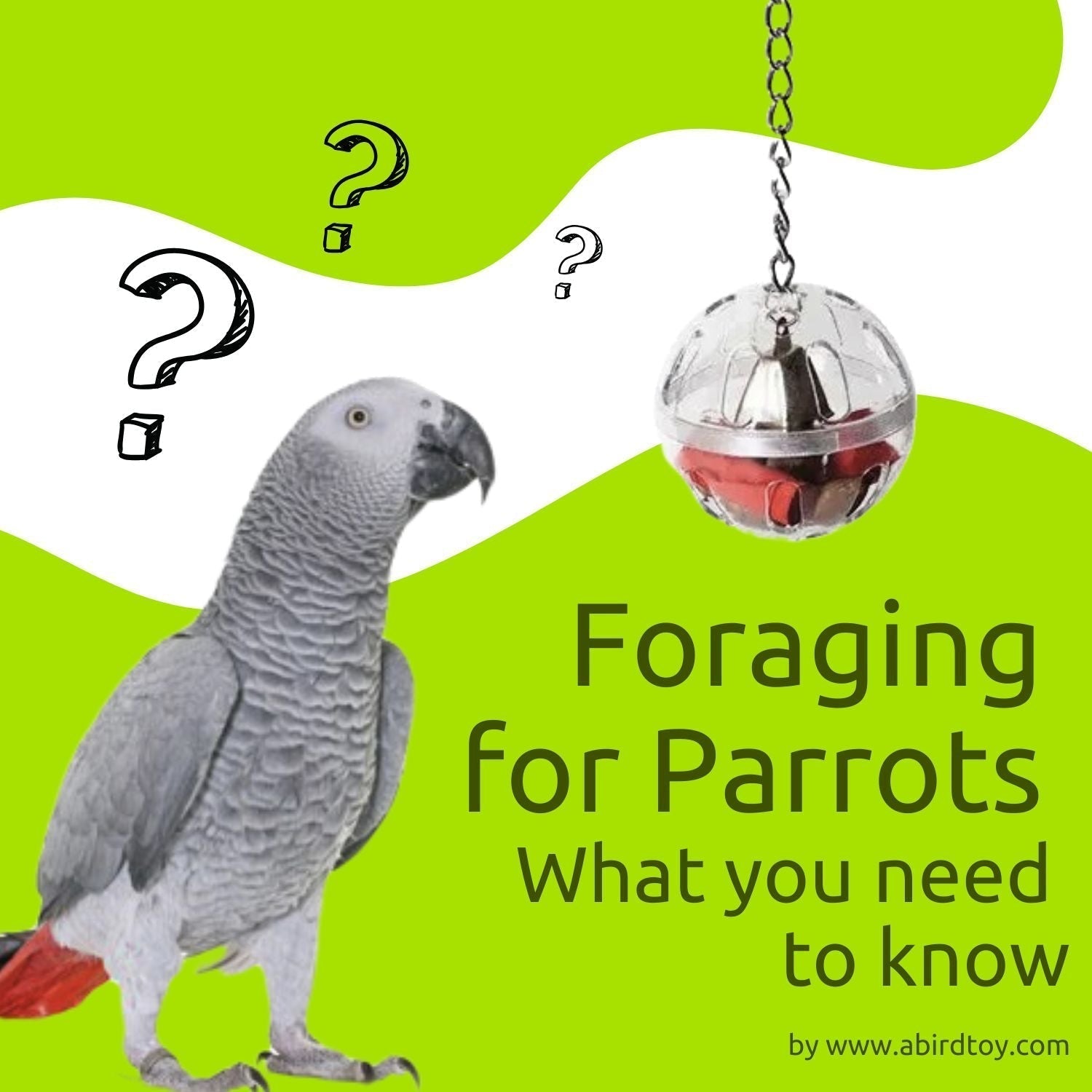
Parrots in the wild are clever, curious, and endlessly busy. In their natural habitats, these birds spend most of their day searching for and handling food: a constant mental and physical workout, a way to stay engaged, and a core part of what makes a parrot happy and healthy.
It's no surprise that experts are by now recommending that every pet parrot gets to forage daily. But how do you get your bird to work for its food if it's never done so before?
Why is foraging important for parrots?
What does a pet parrot spend its day doing in the wild? There's plenty of sleeping and (mutual) preening involved, and important activities like nest site maintenance or caring for young during the breeding season also take up time. But mostly, parrots forage.
Forage (/ˈfɒrɪdʒ/): (of a person or animal) search widely for food or provisions.
Psittacines have evolved keen brains in order to scrounge together their daily meals of seeds, nuts, wild fruits, flowers, and whatever seasonal treats may be around. Not only are they effective at finding the food, but they're also supremely good at figuring out how to access it: cracking the nuts, extracting the seeds, peeling the fruit. These birds are food-finding machines, although the task of staying well-fed does still take up the majority of their days.
To explain why being able to express these built-in foraging behaviors is so important to parrots, we like to use the example of busy people who love their jobs suddenly being forced to retire. You know the ones: without their work and with no hobby to replace it, they become frustrated or even depressed. Parrots really aren't that different! If you just toss their daily meals in their food bowl and be done with it, you take away a very large part of what they are built to do, leaving little in its place. The resulting frustration may be directed at you (aggression) or at the bird itself (feather plucking, automutilation).
Keeping feeding time simple may be easier for you, but your bird would like to put in the work, thank you very much. We're not just saying that: researchers have discovered that parrots really do like to have a degree of control over how they spend their time. They will sometimes choose food that requires foraging behavior to get to over easily accessed meals, a concept known as "contra-freeloading".
It appears our feathered friends know what's good for them. There is ample evidence to suggest that allowing a bird to forage helps keep it sane; studies with titles like "Foraging opportunity and increased physical complexity both prevent and reduce psychogenic feather picking by young Amazon parrots" (2003) and "Contrafreeloading indicating the behavioural need to forage in healthy and feather damaging grey parrots" attest to this (once you cut through the academic speak, anyway).
Did you know? Foraging is a double whammy. Although we tend to associate it with mental health in parrots, having to work for their food also motivates them to move. Considering the prevalence of obesity and fatty liver disease in our pet birds, that's a very, very good thing.

Foraging makes parrots happy—and they get really into it!
Put those birds to work
Your parrot needs to forage, that much is clear. But… how do you make them do it? If your pet has only ever seen food in a bowl, it's unlikely to even recognize it when it's presented in a more challenging form. How do you know there's tasty stuff inside a walnut if you've never been shown what to do with the woody shell?
Don't worry: foraging is just food puzzles, and as with other types of puzzles, their difficulty level varies. Below, we'll first take a look at beginner-level parrot foraging options. Once you feel like your bird has grasped the concept, you can start upping the difficulty. Whatever its species or level of foraging expertise, try to present your parrot with at least one food puzzle a day from now on. You'll love seeing it putting its clever mind to work and display its natural behaviors.
Tip: Depending on what motivates them, some parrots may also like to forage for small toys.
Foraging for beginners
If your parrot is the sort that gets confused when presented with a vegetable and thinks its food has disappeared if you move the bowl around, you'll need to take it slow and design easy puzzles. Even just taping a strip of paper over the middle of the food bowl is a good start—your bird can still see its meal, but will have to go through or around the paper.
Other beginner-level foraging toys and opportunities include:
- Simple foraging box: let your bird see you pour its favorite food into one of our Foraging Flats. It can take a while (sometimes days) for them to go for it, but most can't resist diving in to find the snacks.
- Birdie kabob: special skewers that you can use to present tasty treats, vegetables, and other parrot snacks in a novel way.
- Potted herbs: get an organic basil plant and place it near your bird's favorite hang-out. Your home will smell great for days as it nibbles on the leaves! Wheatgrass also works.
Tip: Sometimes getting your parrot to forage means having to go out and forage yourself. If you can get them from a pollution-free area like your garden, bird-safe branches with fresh flowers, leaves, and buds prove irresistible to most parrots. If yours seems apprehensive, check out our article on parrot neophobia for tips on desensitization.
Foraging for experts
Parrot jumping into the foraging box as soon as you bring it out? Basil plant demolished, branches stripped? Great, your bird is catching on. Time to up the stakes and see how far you can take it!
You'll get the hang of creating foraging challenges just like your bird will get the hang of solving them, but here's some inspiration:
- Simple foraging toys: balls, tubes, or cubes that allow your bird to see the food but require basic manipulation to actually reach it.
- Food bowl covering: instead of just a strip of paper, try covering the whole bowl, leaving only a small hole for visibility.
- Cup toys: consist of little cups with lids that can be lifted by a bird beak, or a variety of cups stacked on top of each other. Fill with treats and let's go!
- Egg carton: place food inside and close, optionally leaving holes for visibility. For an extra challenge, wrap the food in something like paper.
- Expert foraging toys: complicated food towers and wheels that really require a parrot to sit and think.
Remember to choose a foraging option that fits your parrot's size. Advanced foraging toys like wheels are usually best left to the big birds; flimsier options like paper coverings work well for the smaller species. All parrots benefit from foraging opportunities, even tiny budgies!
Conclusion
Busy beaks belong to happy parrots. Socializing is great, but teaching your parrot to forage means it can keep itself busy when the need arises—and they genuinely seem to enjoy it. If you start slow and work your way up with the help of lots of food and patience, your bird will be a foraging expert before you know it.
Sources
Beekmans, M. H. C., Vinke, C. M., Maijer, A., de Haan, I., Schoemaker, N. J., Rodenburg, T. B., ... & van Zeeland, Y. R. A. (2023). Increasing foraging times with appetitive and consummatory foraging enrichment in grey parrots (Psittacus erithacus). Applied Animal Behaviour Science, 265, 105986.
Coulton, L. E., Waran, N. K., & Young, R. J. (1997). Effects of foraging enrichment on the behaviour of parrots. ANIMAL WELFARE-POTTERS BAR-, 6, 357-364.
Meehan, C. L., Millam, J. R., & Mench, J. A. (2003). Foraging opportunity and increased physical complexity both prevent and reduce psychogenic feather picking by young Amazon parrots. Applied Animal Behaviour Science, 80(1), 71-85.


