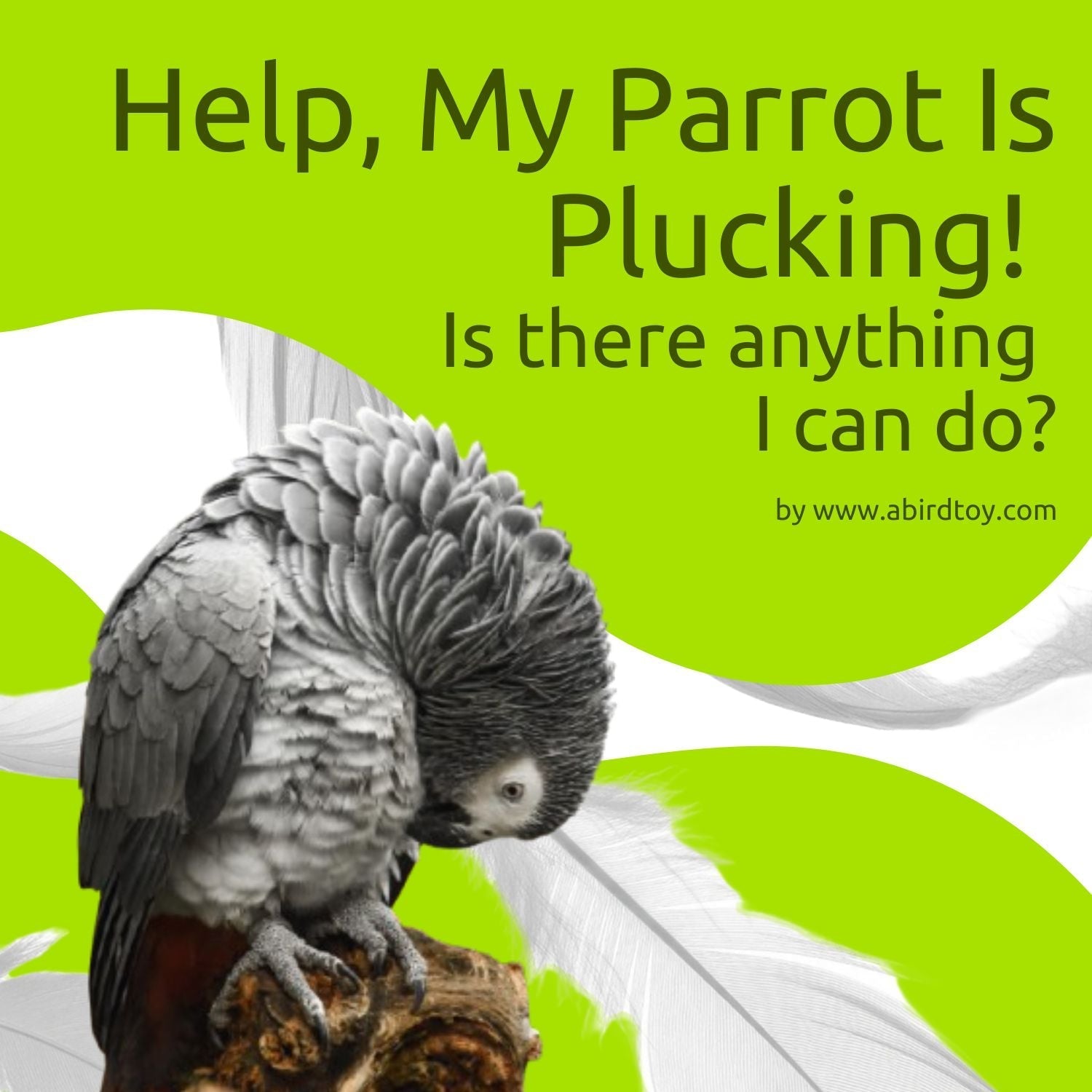
Feathers piling up on the cage bottom? Parrot looking a little bare, and spending a lot of time preening? It’s time to start paying attention, because you might have a plucker on your hands.
It can be hard to understand what drives a parrot to rip out its own feathers, and getting it to stop can be even more challenging—but there is hope.
What is feather plucking?
Before we get into the details, it’s important to get the terminology right. When we talk about feather plucking in parrots, we’re not only referring to the act of a bird pulling out its own plumage. Self-damaging behaviors can also include chewing the feathers (often called barbering), or even picking at the skin when no feathers are available. Heck, some parrots start plucking other birds rather than themselves, but the underlying causes are often the same.
Because "feather plucking" doesn’t quite cover it, ornithologists use terms like "plumage disorder", "pterotillomania", "feather damaging behavior" (FDB), and even "automutilation" in cases where plucking goes beyond just feathers. So when we talk about feather plucking, keep in mind we’re talking about any disorder that causes a parrot to damage its own body.
The next question, of course, is why? What drives these beautiful, hyper-intelligent birds to do something as silly as pulling out their own feathers over and over again, sometimes to a point where they’ll never be able to regrow? What causes some of them, especially African greys, to begin digging into their own sternums once the feathers are gone?
Why do parrots pluck their feathers?
If you’re a human with a picking disorder like trichotillomania or nail-biting, parrot feather plucking probably sounds pretty familiar—because it is. Ornithologists have found that, much like when humans begin to pull out their own hair, a mixture of urge-driven and compulsive components is at play. If that sounds complicated, don’t worry, because it'ss really not.
The urge is caused by the fact that pulling out a feather—or hair—provides a brief sensation of relief, thought to be the result of the brain engaging certain reward pathways. Yes, pulling out its feather is uncomfortable for the bird, but it also seems to trigger the release of endorphins and other hormones that make it feel good. That is, until it doesn’t anymore, and the behavior becomes automatic and ritualized: a compulsion. At this point, they don’t pick for relief. The behavior has become an automatic response to stress or downtime, rather than something the bird consciously chooses to do.
That last bit there sums up why feather plucking (or FBD, or whatever you prefer) is so insidious. Once a parrot starts, it can be almost impossible to make it stop.
Tip: Broody parrots may pluck the feathers on their chest to better be able to warm any potential eggs. This isn’t a problem in itself, but do keep an eye on your bird to make sure it stops once it’s done nesting.

Cockatoos are one of the most high-risk species for pterotillomania.

Barbering/overpreening is another form of pterotillomania.

❌ Bald head? This can indicate a bird being plucked by a flock member, but in the case of this juvenile wild cockatoo, it's more likely to be a virus known as psittacine beak and feather disease (PBFD), which affects plumage and is unfortunately often deadly. It doesn't hurt to get your parrot tested for PBFD; if it's losing feathers on its head or around its eyes, you definitely should.
How do I stop feather plucking in my parrot?
To stop the feather plucking, one must know the feather plucking.
- A Bird Toy
Or, in more actionable language: to stop it, you need to know why it’s happening, which can be easier said than done. There are as many causes for feather plucking as there are parrots who pluck. This being said, most pluckers first develop the urge as a result of either physical or psychological discomfort. These can turn a normal behavior, like self-preening, into a maladaptive one.
Physical causes
Whether the plucking is a new or old habit, your first stop should be an avian vet. They can perform a full health panel, including tests for parrot beak and feather disease, a stool test, blood chemistry, and more. Itchy skin (low humidity, external parasites, allergies, infection), nutritional deficiencies, and all sorts of chronic and systemic diseases can cause a parrot to pluck—even if the problem is on the inside, not the outside. A poor wing trim can do it, so don’t rule anything out!
If any of the tests comes back positive, the vet should be able to tell you how to proceed. Keep in mind that except in very obvious cases, like when an allergy causes constant itching, there’s no actual guarantee this particular health issue is making your parrot pluck. Combined causes, like “dermatitis + boredom,” are common. Also, if it’s been long enough for the behavior to become compulsive rather than just an urge, there may in fact be more to stopping it than fixing the underlying cause. Still, curing any physical ailments should obviously still be your starting point!
Psychological causes
Where next if your parrot receives a clean bill of (physical) health? Or maybe it has a chronic disease, or plucking persists after the disease or deficiency has been fixed? That’s where we enter into different territory, where physical tests aren’t of much help anymore. And while some of our feathered friends can talk, that unfortunately doesn’t mean they're able to explain what’s bothering them.
As we saw earlier, mental distress is a prime cause of feather plucking. Parrots are highly intelligent, but they’re also sensitive, particularly the larger species. African greys, cockatoos, and Eclectus parrots are especially notorious pluckers, but even a budgie can end up picking itself or its cagemate(s) bald. A move, their owner or cagemate passing, or a new job taking up all their human's attention: big changes are always a time to keep a closer eye on your parrot.
Arguably even worse is chronic mental distress. We humans love to keep parrots in our homes, but we’re not always as well-educated on what they need to thrive as we should be. Physical factors like proper nutrition—still an issue in parrot husbandry—aside, many folks struggle to understand what their bird needs; or worse, they don’t care (and end up giving the bird away, which is why rescue birds are often pluckers). To prevent and hopefully even cure feather plucking, it’s important to be in tune with your parrot.
As with humans, there are many factors. Physical mistreatment, like yelling or swatting at a bird, can do it. So can our parrots’ often raging (seasonal) hormones, which are complicated enough to warrant an article of their own! But the biggest culprit? Simple boredom.
A lack of stimuli, loneliness, neglect, and an inability to move about can all be seen as variations of the same thing, and despite all the improvements to parrot care in recent years, they’re still making some of our flock members sick. Ornithologists have pointed to the lack of foraging opportunities for our pet parrots: they spend a huge part of their time in the wild using their smart brains to find food. When those hours of puzzle-solving are taken away, what's left to them except maybe to hang out with their humans, and over-preen their feathers when the “flock” isn’t available?
If we consider all this about what makes a parrot pluck, we can come up with a basic action plan. As we’ve mentioned, you should take your parrot to a specialized avian vet before you do anything else, and they’ll have plenty of points for you to consider. But here's what you can think about in the meantime:
Review care
It can be hard to scrutinize your own actions and the way you care for your pet, but rest assured that even parrot experts do it all the time. Admitting you don’t know everything is key!
- Does your parrot get multiple hours a day to roam free in a safe environment?
- Is your parrot’s cage large enough for the time it does spend inside?
- Does your parrot have company during most of the day, in human or bird form? Just sitting in the cage while you’re at home doesn’t count.
- Does your parrot have plenty of toys to play with?
- Do you approach and handle your parrot appropriately?
- Could something be off about the environment, i.e. too dirty, sunny, dry, interferes with sleep, or similar?
- Could your parrot be hormonal from a lack of sleep, being pet in the wrong places, or having access to potential nesting spaces?
- Does your parrot receive regular (mist) baths?
And last, but most certainly not least: can your parrot forage for a couple of hours a day? Does it have foraging toys or a foraging box? Do you offer food in a variety of ways?
Almost all of these points have to do with a lack or excess of stimulation. Remember: if a parrot’s brain is left to its own devices, it might turn to plucking to cope. These highly social birds are almost never alone in the wild, which means that loneliness in particular can increase the risk of maladaptive behavior.
Tip: If your parrot is scared of toys and new foods, you’ve got a neophobic on your hands. Careful exposure training with positive reinforcement can go a long way in combating this, which in turn might improve the plucking situation.
Diet
This point is so important we wanted to extract it from the general care review section. Diet is everything. Varied, healthy meals can make the difference between a miserable, featherless parrot and a healthy, vibrant one. This is why we’ve already published about parrot diet pretty extensively, but let us quickly review the basics here.
Most importantly, a parrot can’t thrive on a dry seed mix alone. The lack of variety can cause vitamin A deficiencies, obesity, fatty liver disease, and other issues that appear to be directly related to feather plucking.
Seeds can form part of their daily meals, but a high-quality freeze-dried parrot food or pelleted solution works best as a staple. And it shouldn’t end there, either, because even though our birds go nuts for them (and they’re highly nutritious), no one should live off dry, brown granules alone.
As we’ve seen, adding variety to a parrot’s diet doesn’t just help ensure it gets plenty of (micro)nutrients, but also supports its mental health in the long run. You should vary the food—lots of fresh veggies, some fresh fruits, and a regular rotation of fun snacks—as well as the way you present it. Today it’s romaine lettuce on a swinging skewer, tomorrow it’s a big chunk of sweet potato: to your parrot, foods should be toys as well as nutrition.
Other measures
Collars and t-shirts for plucking birds can be found in pet stores. There are also soothing sprays available, like with Aloe or chamomile, and even various supplements that may or may not help. Should you try any of those?
If you can’t see the forest for the trees, do nothing for now and ask your avian vet instead. A natural spray won’t do any harm as long as you keep it away from your parrot’s face, but supplements should be thoroughly checked (take their promises with a grain of salt). Collars are particularly finicky: they can work as an emergency stopgap, but may also stress your parrot out so much the behavior becomes worse.
Conclusion
Feather plucking in parrots is very common, particularly in larger species. But that doesn’t mean it’s incurable! Even though getting a parrot to stop ripping out its own feathers can be a long and frustrating process, there is hope. Remember that your bird is trying to manage its stress, or at least it was at some point—it may not remember how to not pluck.
Recovery means reducing stressors and redirecting the behavior to more useful activities like foraging, so your timeline to recovery is usually measured in months, not days or weeks. Hang in there. At the very least, you’re getting to know your bird better every single day you try.
PS: Our scientifically minded readers may want to take a deeper dive. We recommend “Feather damaging behaviour in parrots: A review with consideration of comparative aspects” (2009) to start.


